cff

Sunday, 11 December 2011

Joseph Cornell's work

Joseph Cornell is another of the artists from the unit 3 briefing who I find particularly interesting because there is a sense of distress and vintage about his work. You wouldn't want to touch it in fear you would damage it because his pieces seem to have some strange value about them.

Image Detail

Yet if we were to know that the elements that build up his pieces are found or collected unwanted bits and bobs we may well question the value of them. That is something really interesting about Cornell's work though, we do know that these parts are collected up but there is still the sense of importance and value. Maybe it is the fact that it does in a way document Cornell's own journeys and in a way the journey of the elements after they were disowned.
Image Detail
Cornell's work is rather ambiguous because a viewer could have many an interpretation of it. Yes there is the idea of a journey but it is up to us to make up the narrative for this journey. You could argue that the journeys are to do with Cornell's love for Victorian visual culture as this is where most of the objects are from but this is just one interpretation of many.'Cornell's work can be easily framed in biographical terms. One need not dig too deeply for psychoanalytic readings, for the Freudian tropes (an absent father, an idyllic childhood, a sudden fall from grace, familial obligations, a fraught relationship with his mother) present themselves readily.' (Houng, 2007) His work is like a story of someone's life however, it also isn't at the same time. Cornell didn't like the idea of biographical sense within art because it strips the mystery. He wanted the viewer to try to dig deeper into his work, to hunt for the meaning inside it.
His work feels uncanny because there are these objects we are familiar with but they are part of something unfamiliar, something whose meaning is not clear to us, a meaning you could relate to Bernstein's restricted code because other than Cornell himself his work is obscure.  'One experiences the uncanny sensation of wandering through another man's mind.' (Houng, 2007) It is also uncanny because we feel like we are intruding on Cornell's mind, it is as if we have unscrewed the top of his head to see how his mind works. These collages simulate his mind at work and there is something unusually eerie about it.

Joseph Cornell's work also reminds me of artist Kurt Schwitter's work because he too creates collages of objects mainly things viewed as rubbish like train ticket stubs and again the meanings of his work are obscure.


American crafter Tim Holtz does something similar to both artists in that he gathers up objects and distresses them up to change meanings of them, he also uses them alongside photographs to add new meaning to the photographs. Yet this meaning is still sometimes ambiguous.

Image Detail 
Patchwork Creativeblocks

Here is some work I did for my A Level exam looking at Joseph Cornell in the theme of cycles which to me was his cycle of journey.


Perception Essay on Fight Club

Just thought I would post up my final essay to archive some of the theories and ideas I have learnt throughout the perception lectures and seminars.

In What Ways Does an Understanding of Perception Have an Impact on the Work of Designers

Friday, 9 December 2011

Photoshop: Week 12

Today in photoshop we were practicing more with textures, this time creating a frame from scratch. We used techniques such as masking, linking layers, and quick selection to produce our frames as well as our digital painting techniques to blend together stock images on our frames. Here is the process for my frame.

Frame shape blocked out.

Stock image textures added and blended.

Colour and lighting and shadow added as well as border detail through the stroke option.

Background added through a mixture of stock images and a drop shadow for depth.

My finished frame. Added some text picked out from the typewriter letters that I felt suited the image.

Technical Exercises: Maya Pirates Cove Barrel

Here are the results for my barrel so far, with the texture material alone then with the bump mapping.


Technical Exercises: Maya Pirates Cove Gems

Added the texturing materials to the gems and pearl necklace of the pirates cove, was quite simple to do and learnt to duplicate an existing material then edit them rather than creating new ones completely from scratch.


Wednesday, 7 December 2011

Edward Hopper's work

During the briefing Phil showed us some of Edward Hopper's work which I was really happy to find out linked to this brief because he is actually my favourite artist. I find it quite hard to explain just why he is, there is just something in his work like a deep story which the viewer tries to decipher that just grabs my attention, and the space he conveys within his work just grasps me. I remember first looking at his lighthouse scenes and feeling quite lost and in despair because the scenes seem so empty yet so full. These massive lighthouses surrounded by... well nothing but are so powerful in making the viewer think of the wonders of these lighthouses and ask themselves what made Hopper paint this.

Biografia di Edward Hopper
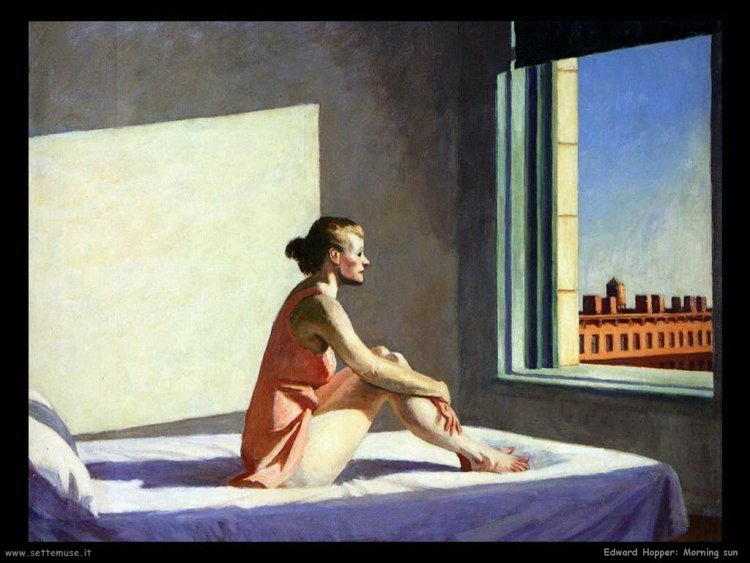
Fig 1. Morning Sun

Hopper's work is always suggested as framed but it isn't always the framing of just one specific focus, there sometimes feels as though there is a split in the framing which draws the viewer's eyes from one focus to the other. This seems to suggest Hopper's idea of the world of the main subject not being the only world, this is especially evident in paintings where windows feature. The subject looks outside aware of the existence beyond their own whereas, the viewer can only see the subject and a fragment beyond the window. Hopper shows alienation of this figure but also of what the viewer knows of this painting yet there is some sort of hopefulness about these scenes where the figure seems to be reaching out to this existence.

Fig 2. Nighthawks (1942)

There is an ambiguous sense about his paintings in that the viewer is left to try and figure out what is happening. There is no clear ideology or meaning behind the scenes, the viewer creates their own story. Take Nighthawks for example, the male and female beside each other could be having an affair and the man alone for all we know could have been paid to keep watch on them or even have nothing to do with them, rather having a secret that he needs to tell the barman.

 
Image Detail
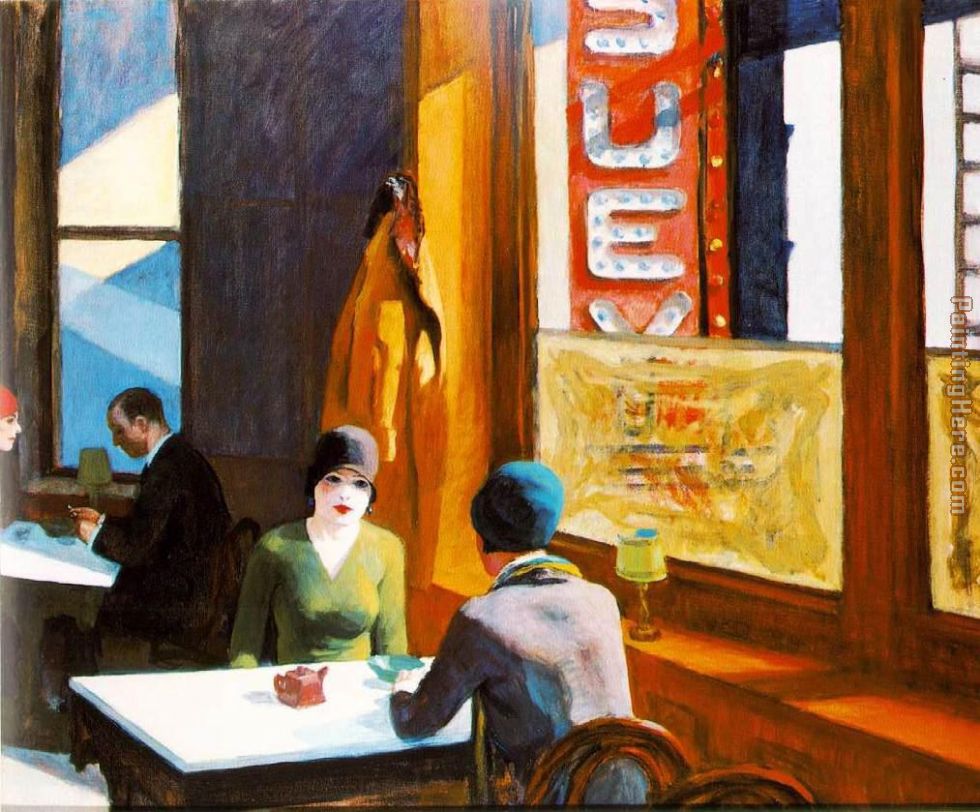
Fig 3. Chop Suey (1929)

With some of Hopper's paintings his figures feel doll like or like mannequins where they have been positioned in such ways that Hopper felt suitable. It is not just their pose but their faces that feel emotionless and make them feel even more like an object of these scenes rather than important figures that tell a story. They are used rather to allow the viewer to convey their own perception of the paintings. You could even view these paintings as if Hopper had a dolls house and had arranged his props in such a way then used the environment as a basic of his painting. If you were to carry on the lines of these paintings such as Chop Suey it could reveal just that.

Fig 4. Second Story Sunlight (1960)

What is uncanny about Hopper's work is the voyeuristic pleasure the viewer is allowed into the painted figures lives. There is a simplistic view on life and as Gregory Crewdson puts it 'It’s amazing how many of Hopper’s pictures feature something as simple as a bed, windows, or doorways. I think this serves to emphasise further the viewer looking with a kind of voyeuristic gaze into the world.' (Crewdson, 2004) The viewer feels as if they shouldn't be watching what they are seeing and feel guilty peering into these worlds but this doesn't stop them continuing to gaze if anything it makes them want to look more because they want to know what is actually happening through these ambiguous scenes. These scenes feel like they could be real representations of life and this just allows the viewer to give these characters sad stories. Hopper's positioning of his characters and objects within the scenes makes them look as though they are meant to be viewed but because we see beyond this into a representation of reality this feels uncanny to us. Weird to look into someone's private life so freely.
Fig 5.

Bibliography

Crewdson, G. (2004) Aesthetics of Alienation http://www.tate.org.uk/tateetc/issue1/article10.htm (Accessed 07/12/2011)

Illustrations List

Figures 1-5. Hopper, Edward [Oil on canvas] Settemuse http://www.settemuse.it/pittori_scultori_americani/edward_hopper.htm (Accessed 07/12/2011)


Life Drawing: Week 12

This week we were pretty much allowed to do what we wanted but we had to do a tonal study as one drawing. For this drawing I focused on getting the tones down first as we weren't allowed to draw the outline. I blocked in shapes of tone then worked on top of them to make the form of the figure.

2 minute warm ups

Tonal Study

Pen study